Show Notes
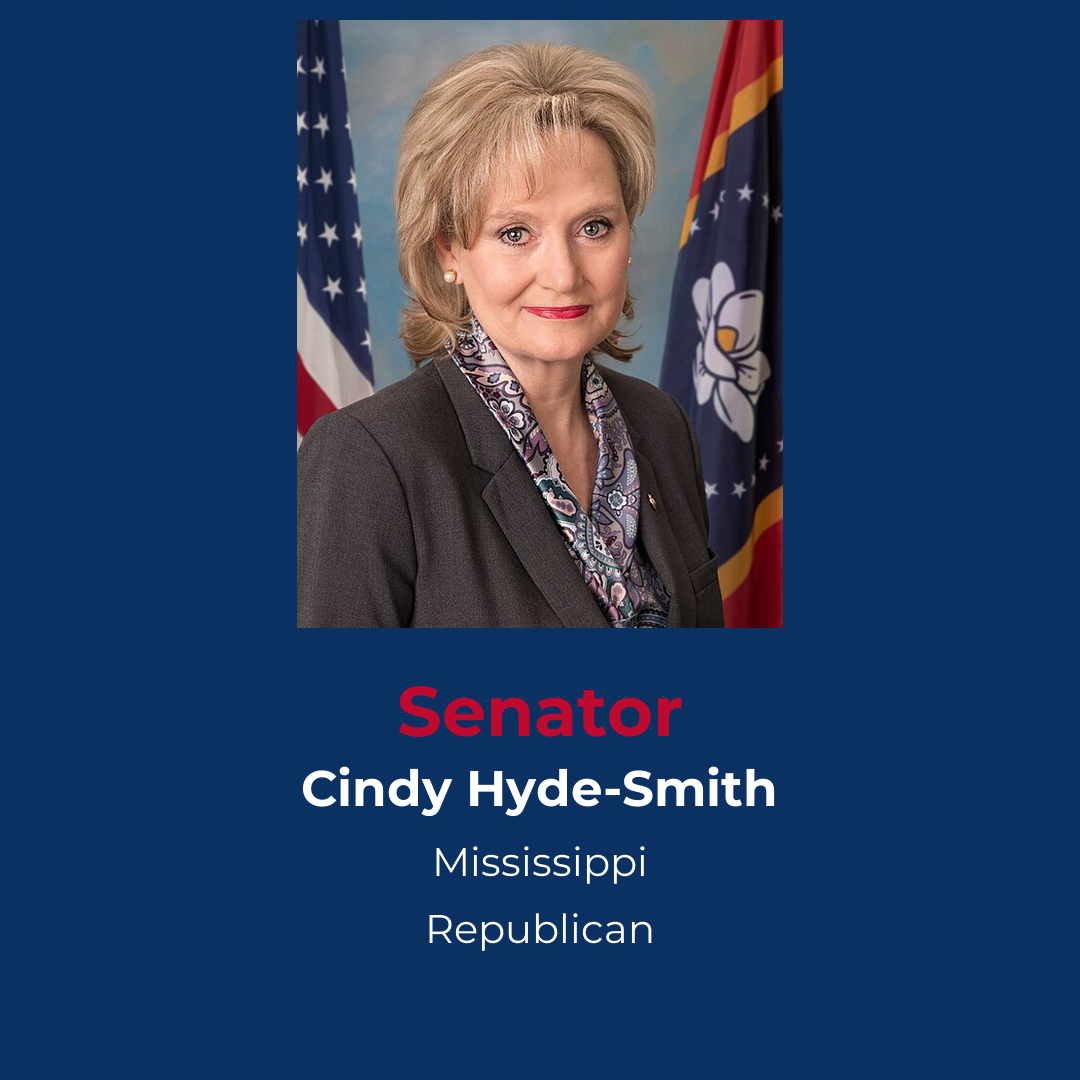
Cindy Hyde-Smith made history in 2018 as the first woman to represent Mississippi in the United States Congress. Before arriving in Washington, she served 12 years in the Mississippi State Senate and was the first female to be elected as the Mississippi Commissioner of Agriculture and Commerce.
She represents Mississippi, a deeply conservative, agriculture-heavy state in the Deep South. A lifelong cattle farmer herself, Hyde-Smith’s political identity is intrinsically tied to the state's $7.5 billion farming and forestry industries.
In the 119th Congress (2025-2026), Hyde-Smith received a massive elevation in power. She was officially named the Chairman of the Appropriations Subcommittee on Transportation, Housing and Urban Development (THUD). This "Cardinal" position gives her direct control over the federal budget for highways, aviation, and national housing grants.
She is currently the Chair of the Senate Pro-Life Caucus, making her a leading conservative voice on social issues. In early 2026, she introduced a resolution honoring Mississippi's Gestational Age Act and led a coalition urging federal health agencies to protect the "conscience rights" of medical residents who oppose performing abortions.
Looking ahead to the 2026 midterms, Hyde-Smith is running for re-election in what promises to be a highly watched race. She is facing a prominent Democratic challenger in Scott Colom, a reform-minded District Attorney who recently secured the influential endorsement of Mississippi Congressman Bennie Thompson and has amassed a significant campaign war chest.
"From the cattle pastures of Brookhaven to the chairman's gavel on the Appropriations Committee, Cindy Hyde-Smith is the quiet, agriculture-first conservative delivering federal dollars to the Deep South."
Day 50 | Cindy Hyde-Smith: The Farmer with the Federal Checkbook
Cindy Hyde-Smith’s political career is deeply rooted in the soil of Mississippi. A native of Brookhaven, she grew up in the agricultural industry and continues to operate a cattle farm with her husband. Her entry into politics was straightforward and hyper-local: she served as a conservative Democrat in the Mississippi State Senate for over a decade before switching her affiliation to the Republican Party in 2010. Shortly after, she was elected as the state’s Commissioner of Agriculture and Commerce, a role that perfectly aligned with her expertise and cemented her popularity among rural, working-class voters.
Appointed to the U.S. Senate in 2018 to fill the seat vacated by Thad Cochran, Hyde-Smith won the subsequent special election and has since established herself as a reliable, institutional conservative. Unlike some of her more bombastic colleagues in the Senate, Hyde-Smith generally avoids cable news combat, preferring to focus her energy on the Appropriations Committee, where she methodically secures massive infrastructure and agricultural grants for her state.
In the 119th Congress, her methodical approach paid off immensely. Taking over as the Chairman of the THUD Appropriations Subcommittee, Hyde-Smith now writes the funding bills for the Department of Transportation and the Department of Housing and Urban Development. She also secured a highly coveted new spot on the Military Construction and Veterans Affairs (MilCon-VA) subcommittee, meaning she now sits on six of the twelve Appropriations subcommittees. She has used this leverage to aggressively fund local priorities, recently voting in January 2026 to pass an Army Corps funding bill that directed $184.1 million to Mississippi projects, including the long-debated Yazoo Backwater Pumps.
As she navigates her 2026 re-election campaign, Hyde-Smith is balancing her role as an Appropriations power broker with her status as a staunch cultural conservative. She has fully aligned herself with the new administration's "Peace Through Strength" agenda, voting to advance the FY2026 National Defense Authorization Act. Domestically, she cosponsored the 2026 bill to require proof of U.S. citizenship for voter registration and introduced legislation to bring the Grand Village of the Natchez Indians into the National Park System. She will need to rely on this mix of cultural conservatism and federal deliverables as she fends off Democratic challenger Scott Colom in November.
State Context: Mississippi (U.S. Census Data) The Magnolia State: Mississippi is the geographic and cultural heart of the Deep South, bordered by the Mississippi River to the west and the Gulf of Mexico to the south.
Population: ~2.9 Million.
Demographics:
Highly Diverse: Mississippi has the highest percentage of Black Americans of any U.S. state (approximately 38%). The remainder of the population is predominantly White (56%), with small but growing Hispanic communities.
Economic Drivers:
Agriculture & Forestry: The state is an agricultural powerhouse, particularly in poultry, soybeans, cotton, and timber. It is a $7.5 billion industry that forms the backbone of the rural economy.
Manufacturing & Defense: Shipbuilding is a massive industry on the Gulf Coast (specifically Ingalls Shipbuilding in Pascagoula, the largest private employer in the state). The state also hosts vital military installations like Keesler Air Force Base.
Politics: A Solid Republican State (R+11). Despite having a large, reliably Democratic African American voting base, the state's white electorate votes overwhelmingly Republican, giving the GOP a heavy advantage in statewide elections.
Source: U.S. Census Bureau & Data USA
#Senator #Mississippi #Republican #CindyHydeSmith