Show Notes
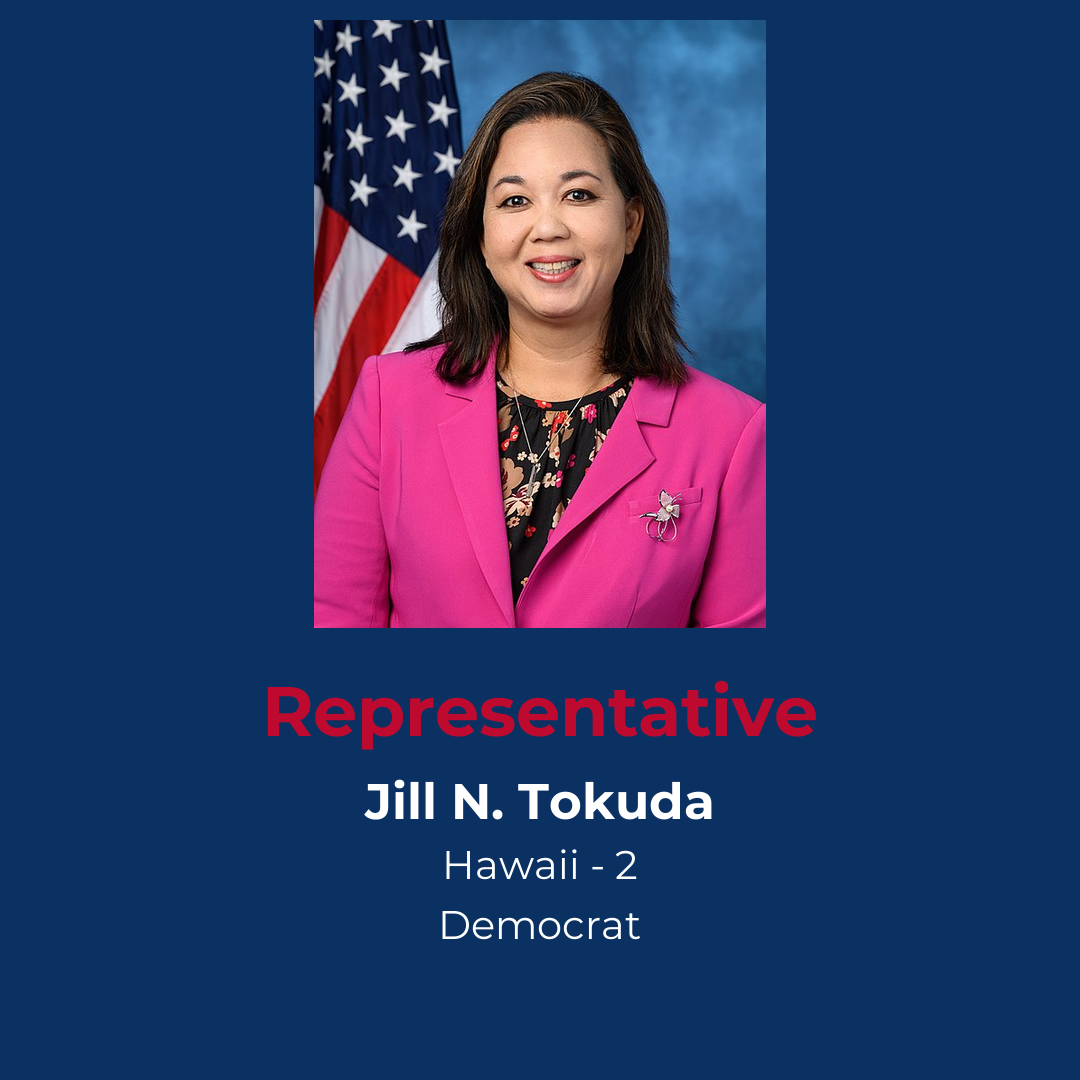
Jill N. Tokuda represents one of the most geographically massive and diverse districts in the country, covering the "Neighbor Islands" of Hawaii and rural Oahu. Before her election to Congress in 2022, she spent 12 years in the Hawaii State Senate, where she chaired the powerful Ways and Means Committee and balanced the state's $14 billion budget.
She is a prominent voice for Asian American and Pacific Islander (AAPI) leadership in Washington, serving as the Second Vice Chair of the Congressional Asian Pacific American Caucus (CAPAC). She also co-founded the Bipartisan Rural Health Care Caucus, leveraging her deep understanding of the medical shortages facing isolated island communities.
In the 119th Congress (2025-2026), her influence stretches across three critical domains: Agriculture, Armed Services, and National Security. She was named the Ranking Member of the Agriculture Subcommittee on Conservation, Research, and Biotechnology, making her the lead Democrat negotiating resource conservation in the upcoming Farm Bill.
She is a hawkish progressive regarding the Indo-Pacific. Serving on the Select Committee on the Chinese Communist Party, Tokuda recently introduced the bipartisan Rare Earth Magnet Market Revitalization Act in February 2026 to break America's reliance on Chinese supply chains for critical military and commercial components.
She is aggressively fighting the new administration's immigration policies to protect local economies. In early 2026, she led a bipartisan coalition demanding that DHS Secretary Kristi Noem exempt healthcare workers from a newly implemented $100,000 H-1B visa fee, warning that the policy would decimate rural hospitals in Hawaii that rely on foreign-born doctors.
"From protecting native canoe crops to confronting the Chinese Communist Party on the global stage, Jill Tokuda defends the unique culture and immense strategic value of the Hawaiian Islands."
Day 51 | Jill Tokuda: The Guardian of the Neighbor Islands
Jill Tokuda’s deep political roots are matched only by the vast geography of the district she represents. Born in Honolulu, she earned her degree in international relations from George Washington University before returning home to become a dominant force in local politics. Serving in the Hawaii State Senate from 2006 to 2018, Tokuda proved her legislative muscle by chairing the Ways and Means, Education, and Agriculture committees. She was instrumental in establishing the state's first Executive Office on Early Learning and protecting Important Agricultural Lands. Beyond elected office, her resume spans the private and nonprofit sectors, having served as Co-Director of CyberHawaii and Executive Director of the Nisei Veterans Memorial Center on Maui.
Elected to the U.S. House in 2022, Tokuda quickly established herself as a highly effective, pragmatic progressive. In the 119th Congress, she has strategically positioned herself on committees that directly dictate the survival of the Hawaiian Islands. As the Ranking Member of the Agriculture Subcommittee on Conservation, Research, and Biotechnology, she is the lead Democratic voice fighting for specialized research funding for Hawaii's unique commodities—such as coffee, macadamia nuts, and traditional Native Hawaiian "canoe crops"—while battling the severe threat of invasive species.
Her role on the Armed Services Committee and the Select Committee on the Chinese Communist Party places her at the center of the geopolitical struggle in the Indo-Pacific. Tokuda recognizes that Hawaii is the tip of the spear for the U.S. military, but she fiercely guards state sovereignty. In the FY2026 National Defense Authorization Act (NDAA), she explicitly secured provisions preventing the Department of Defense from using federal authority to condemn or seize state land in Hawaii.
In early 2026, Tokuda’s legislative output has been relentless. She crossed the aisle to introduce the Rare Earth Magnet Market Revitalization Act with Republican Neal Dunn to rebuild domestic manufacturing. Simultaneously, she has taken a hardline stance against the new administration's domestic budget cuts, voting against Department of Homeland Security funding that included expanded ICE budgets, while successfully securing nearly $46 million for the Native Hawaiian Education Program and millions for rural ferry services to keep her isolated communities connected.
District Context: Hawaii 2nd (U.S. Census Data) The Neighbor Islands: Hawaii's 2nd District is one of the most geographically sprawling and unique districts in America. It includes the suburban and rural parts of Oahu, plus the islands of Hawaii (the Big Island), Kauai, Maui, Lanai, Molokai, Niihau, Kahoolawe, and the Northwestern Hawaiian Islands.
Population: ~730,000.
Demographics:
Incredibly Diverse: The district has no single racial majority. It boasts massive populations of Asian Americans (approx. 27%), Native Hawaiians and Pacific Islanders (approx. 24%), and multi-racial residents.
Economic Drivers:
Tourism & Hospitality: The lifeblood of the islands, heavily concentrated in Maui, Kauai, and the Big Island.
Agriculture: The district is famous for its specialized agriculture, including Kona coffee, macadamia nuts, tropical fruits, and sugar cane legacy lands.
Military & Defense: A massive federal footprint drives the economy, though the relationship between the military and local communities requires constant, delicate management (especially regarding land use and water protection).
Politics: A Deep Blue District (D+14). Like the rest of Hawaii, the 2nd District is a Democratic stronghold, allowing Tokuda to comfortably win re-election and focus her attention entirely on federal appropriations and committee work.
Source: U.S. Census Bureau & Data USA
#Representative #Hawaii #Democrat #JillNTokuda