Show Notes
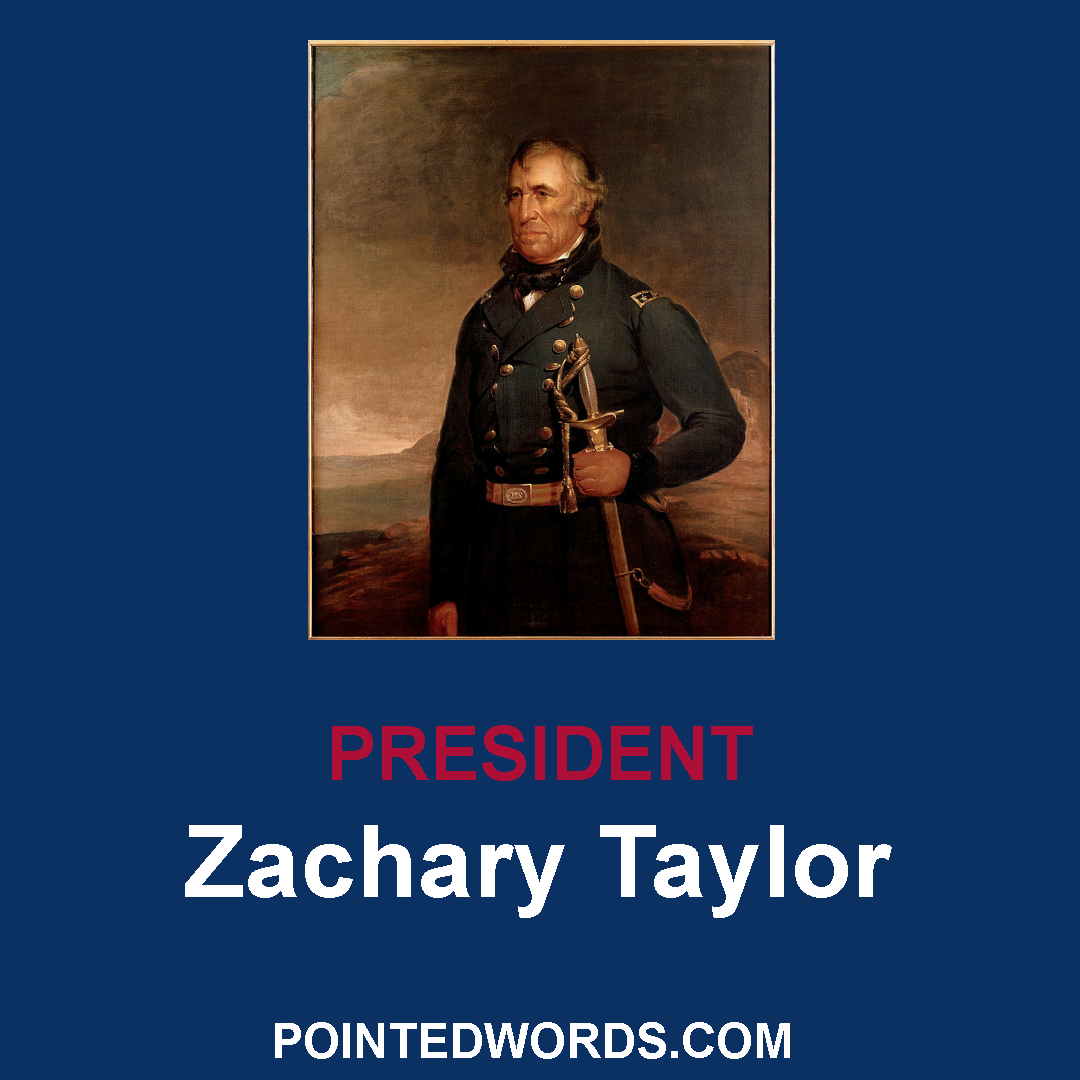
Zachary Taylor was a career soldier who had never voted in an election before running for President. Nicknamed "Old Rough and Ready," he was a hero of the Mexican-American War (winning the Battle of Buena Vista) and was courted by both the Whigs and Democrats because his political views were a complete mystery.
He died in office under bizarre circumstances, sparking one of history's great conspiracy theories. After attending a sweltering July 4th celebration at the Washington Monument in 1850, Taylor consumed a large quantity of raw cherries and iced milk. He fell ill with severe gastroenteritis (cholera morbus) and died five days later. In 1991, his body was exhumed to test for arsenic poisoning; the results were negative.
Despite being a Southern slaveholder from Louisiana, Taylor was a fierce Unionist who opposed the expansion of slavery into the new western territories. He shocked Southern leaders by threatening to personally lead the army to hang any secessionists "with less reluctance than I hanged deserters and spies in Mexico."
His beloved war horse, "Old Whitey," lived on the White House lawn. Visitors would often pluck hairs from the horse's tail as souvenirs, eventually leaving the poor animal partially bald.
Taylor was notoriously unpresidential in appearance. He hated uniforms and often wore a straw hat and dusty civilian clothes on the battlefield, leading new recruits to frequently mistake him for a farmer. This anti-establishment vibe was key to his electoral appeal.
"He was a slaveholder who threatened to hang secessionists. He was a general who never voted. Zachary Taylor was a bundle of contradictions who died by a bowl of cherries."
Zachary Taylor: The Soldier President
Zachary Taylor was the original "outsider" candidate. He spent 40 years in the U.S. Army, fighting in the War of 1812, the Black Hawk War, the Seminole Wars, and finally the Mexican-American War. He was a soldier's soldier: he slept in tents with his men, wore sloppy clothes, and chewed tobacco. His victory at the Battle of Buena Vista, where his outnumbered forces defeated Santa Anna, made him a national celebrity.
The Whig Party nominated him in 1848 not because he agreed with their policies (he barely knew what they were), but because he was a winner. Taylor had literally never cast a ballot in his life. He famously refused to pay postage due on the letter informing him of his nomination, leaving it sitting at the post office for weeks.
Once in office, Taylor surprised everyone. Southern leaders expected him—a wealthy plantation owner from Louisiana—to support the expansion of slavery into California and New Mexico. Instead, Taylor argued that slavery was geographically impossible in the arid West and pushed for California to be admitted immediately as a Free State. When Southern fire-eaters threatened to secede, Taylor exploded. He told them he would personally lead the army to crush any rebellion. He was prepared to veto the Compromise of 1850, which he viewed as a concession to traitors.
But he never got the chance. On July 4, 1850, Taylor attended a fund-raising ceremony at the unfinished Washington Monument. It was a blistering hot day. He returned to the White House and consumed a large bowl of fresh cherries and a pitcher of iced milk. That night, he developed severe stomach cramps. Doctors treated him with the "medicines" of the time—opium, calomel (mercury), and bleeding—which likely hastened his death. He died on July 9, 1850.
His sudden death changed history. His successor, Millard Fillmore, was a compromiser who signed the very bills Taylor had threatened to veto, delaying the Civil War for a decade but arguably making the final explosion worse.
Constituency Context: The United States (1849–1850) Population: ~23 Million.
The Crisis of 1850: The nation was on the brink of disunion over the status of the lands won from Mexico. The Gold Rush had populated California so quickly that it was ready for statehood, forcing the slavery issue to a head.
The Clayton-Bulwer Treaty: One of Taylor's few foreign policy achievements, this treaty with Great Britain agreed that neither nation would exclusively control a future canal across Central America (the precursor to the Panama Canal).
Old Rough and Ready: Taylor’s informality was legendary. He often greeted diplomats wearing a wrinkled suit and slippers. He was the first President to be a career military man with no prior political office (a path later followed by Ulysses S. Grant and Dwight D. Eisenhower).
Source: U.S. Census Bureau & The White House Historical Association