Show Notes
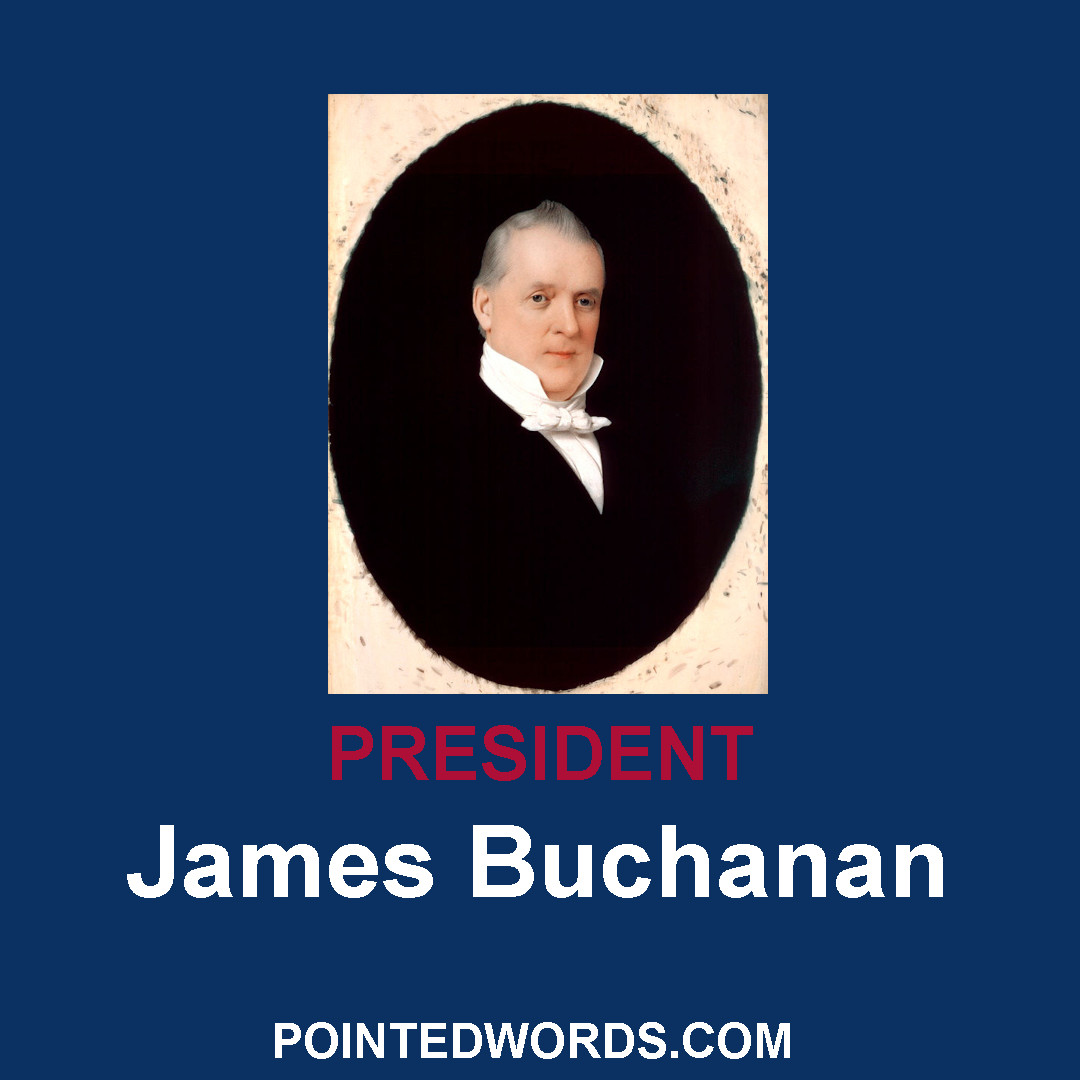
James Buchanan was the 15th President of the United States (1857–1861). He remains the only President elected from Pennsylvania and the only President to remain a lifelong bachelor (his niece, Harriet Lane, served as First Lady).
Despite possessing one of the most impressive resumes in American political history—having served as a Congressman, Senator, Secretary of State, and Minister to Russia and Great Britain—he is consistently ranked by historians as one of the worst presidents in U.S. history.
His most disastrous and unethical action occurred just days before his inauguration. He secretly pressured Northern Supreme Court Justice Robert Grier to join the Southern majority in the Dred Scott decision, hoping a broad ruling denying citizenship to African Americans and allowing slavery in the territories would permanently settle the national debate. Instead, it enraged the North and accelerated the path to war.
He exacerbated the violence of "Bleeding Kansas" by aggressively supporting the Lecompton Constitution, an illegitimately drafted, pro-slavery state constitution. His relentless push for its passage fractured the Democratic Party and sparked a bitter feud with Senator Stephen A. Douglas.
When Abraham Lincoln was elected in 1860 and Southern states began to secede, Buchanan suffered a total failure of leadership. He argued that while secession was illegal, the federal government had no constitutional authority to stop it by force. He sat paralyzed as the Confederacy formed and seized federal arsenals, leaving a shattered nation for Lincoln to inherit.
"He possessed the perfect resume and the absolute worst judgment. James Buchanan is the President who watched the Union fracture and decided that doing nothing was his constitutional duty."
Day 52 | James Buchanan: The Architect of Inaction
If the presidency were awarded purely on the basis of a resume, James Buchanan would have been considered one of the most qualified men to ever enter the Oval Office. Born into a wealthy Pennsylvania family in 1791, Buchanan was a gifted lawyer who spent decades navigating the highest levels of American government. He was a loyal Jacksonian Democrat who served in both houses of Congress, acted as Secretary of State during the Mexican-American War under James K. Polk, and served as a diplomat in Europe. In fact, his absence from the country as Minister to Great Britain during the explosive Kansas-Nebraska Act debates is precisely what allowed him to secure the 1856 Democratic nomination; he was viewed as an untainted, unifying statesman.
The reality, however, was that Buchanan was the ultimate "Doughface"—a Northern politician with deeply ingrained Southern sympathies. He despised abolitionists, viewing them as dangerous radicals, and consistently allied himself with the Southern slaveholding elite to maintain his political coalition.
His presidency was compromised before he even took the oath of office. In a shocking breach of the separation of powers, the President-elect secretly corresponded with the Supreme Court regarding the pending Dred Scott v. Sandford case. Buchanan improperly pressured a fellow Pennsylvanian, Justice Robert Grier, to join the Southern justices in issuing a sweeping ruling. When Chief Justice Roger Taney declared that African Americans could never be U.S. citizens and that Congress could not ban slavery in the territories, Buchanan foolishly believed the issue was legally resolved. Instead, the blatant partisanship of the ruling outraged the North and proved to abolitionists that the federal government had been hijacked by the "Slave Power."
Buchanan's political incompetence was further exposed during the Kansas crisis. Despite clear evidence of massive voter fraud by pro-slavery "Border Ruffians," Buchanan threw the full weight of the presidency behind admitting Kansas as a slave state under the Lecompton Constitution. This alienated Northern Democrats, permanently split his party, and effectively handed the 1860 election to the newly formed Republican Party and Abraham Lincoln.
As the nation collapsed during his "lame duck" period in the winter of 1860-1861, Buchanan's rigid legalism paralyzed him. He declared that states had no legal right to secede, but simultaneously claimed he had no constitutional power to use military force to stop them. He sat in the White House and watched as South Carolina and six other states formed the Confederacy, seized federal forts, and prepared for war. He retired to his Pennsylvania estate, Wheatland, spending his final years hopelessly writing memoirs attempting to defend a legacy that history had already condemned.
Constituency Context: The United States (1857–1861) Population: ~31.4 Million (by the 1860 Census).
The Economic Divide: The nation suffered through the Panic of 1857, a severe economic depression. Because the industrialized North was hit much harder than the cotton-exporting South, Southern leaders grew dangerously overconfident in the economic superiority of their slave-based economy, fueling secessionist arrogance.
Harpers Ferry: In October 1859, radical abolitionist John Brown attempted to spark a massive slave revolt by raiding the federal arsenal at Harpers Ferry, Virginia. While the raid failed and Brown was executed, the event terrified the South and convinced them that the North was plotting a violent race war.
The Fracture of 1860: Because of Buchanan's disastrous handling of Kansas, the Democratic Party split into Northern and Southern factions in the 1860 election. This division allowed Abraham Lincoln, the candidate of the anti-slavery Republican Party, to win the presidency without carrying a single Southern state, triggering immediate secession.
Source: U.S. Census Bureau & The Miller Center