Show Notes
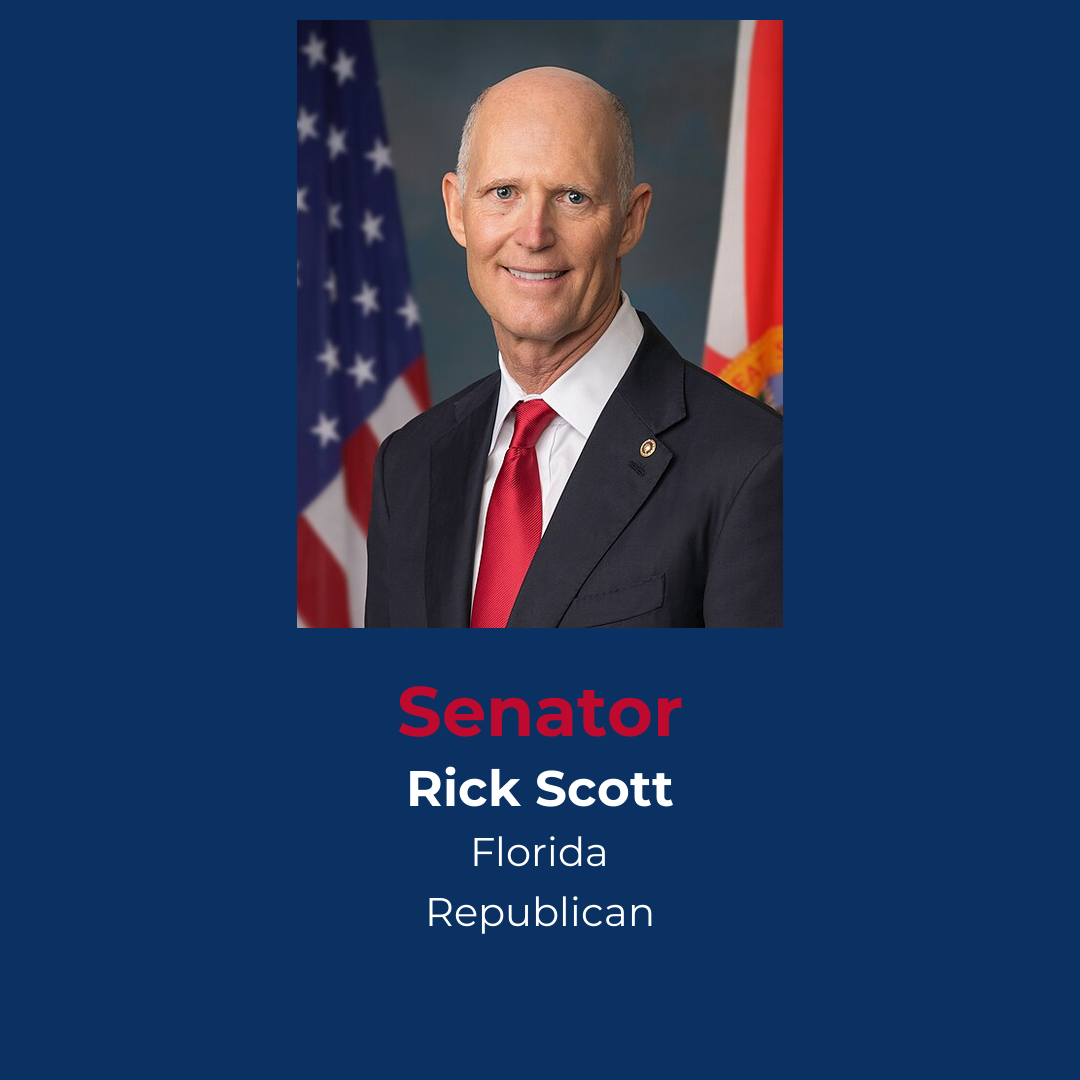
Rick Scott is a dominant force in Florida politics. Before his election to the U.S. Senate in 2018, he served two terms as the 45th Governor of Florida. Prior to politics, he was a highly successful businessman who built Columbia/HCA into the world's largest healthcare company.
He represents Florida, a former swing state that has rapidly transformed into a solid Republican stronghold. He successfully won re-election to a second Senate term in November 2024.
In the 119th Congress (2025-2026), following the Republican takeover of the Senate, Scott was elevated to Chairman of the Special Committee on Aging. This is a highly strategic gavel for a senator representing a state with one of the largest retiree populations in the country.
He is heavily involved in the new administration's economic agenda. Serving on the Budget Committee, Scott is working closely with the Department of Government Efficiency (DOGE) to aggressively cut federal spending and overhaul bureaucratic agencies.
Recent 2026 Legislation: In early 2026, Scott has been driving a massive legislative blitz. He introduced the Federal Disaster Tax Relief Act to extend critical IRS relief to hurricane and wildfire victims through 2026. He is also aggressively targeting the Chinese Communist Party, pushing the TSP Fiduciary Security Act to block federal retirement funds from investing in China, and leading a coalition to end visa programs that allow Chinese "birth tourism" in U.S. territories.
"From growing up in public housing to building a healthcare empire and leading the Sunshine State. Rick Scott brings a relentless, CEO-mindset to the United States Senate."
Day 55 | Rick Scott: The CEO Senator Navigating the New Washington
Rick Scott’s journey to the highest levels of American government is rooted in an extraordinary rags-to-riches trajectory. Growing up in the Midwest in public housing, his adoptive father was a World War II veteran and truck driver, and his mother worked as a store clerk. After serving in the U.S. Navy as a radarman aboard the USS Glover, Scott utilized the G.I. Bill to attend college, eventually opening his first business—a donut shop. Through aggressive expansion and a sharp eye for corporate acquisitions, he went on to build and run Columbia/HCA, creating the largest healthcare company in the world.
He brought that exact corporate, bottom-line mentality to politics. Serving as the Governor of Florida from 2011 to 2019, Scott aggressively championed over $10 billion in tax cuts, slashed thousands of state regulations, and oversaw massive job growth, cementing Florida's reputation as a pro-business haven. Elected to the U.S. Senate in 2018, Scott quickly positioned himself as a foil to the traditional Washington establishment, frequently demanding structural overhauls to how Congress handles the federal budget.
The beginning of the 119th Congress marked a pivotal moment in Scott's career. Fresh off a comfortable re-election victory in 2024, Scott ran for Senate Majority Leader with the vocal backing of the MAGA base and prominent Trump allies like Elon Musk. While he ultimately lost that leadership race to Senator John Thune, Scott emerged as the undisputed ideological anchor for the populist, "America First" wing of the Senate Republican Conference.
Now operating with immense seniority in 2025 and 2026, Scott has secured powerful committee assignments, including seats on Armed Services, Foreign Relations, and Homeland Security. Crucially, he holds the gavel as the Chairman of the Special Committee on Aging. In this role, he is fiercely defending the solvency of Medicare and Social Security while introducing the More Affordable Care Act, which seeks to implement HSA-style "Health Freedom Accounts" to drive down insurance costs.
Simultaneously, Scott is waging a multi-front legislative war against the Chinese Communist Party. In early 2026, he introduced legislation to ban federal Thrift Savings Plan (TSP) dollars from being invested in Chinese companies, and he recently sent a blistering letter to the Department of Homeland Security demanding the immediate closure of an Obama-era visa waiver program that he argues allows Chinese nationals to infiltrate U.S. territories like the Northern Mariana Islands for "birth tourism." Blending his business acumen with a hardline national security stance, Rick Scott is aggressively shaping the conservative agenda of the 119th Congress.
State Context: Florida (U.S. Census Data) The Sunshine State: Florida is the third most populous state in the nation. It is an economic and cultural powerhouse defined by its massive coastal tourism, space industry, and booming agricultural sectors.
Population: ~22.6 Million.
Demographics:
Aging and Diverse: Florida is famous for its massive retiree population, with over 21% of its residents aged 65 or older. It is also highly diverse, with a massive Hispanic population (approx. 27%) that includes deeply rooted Cuban, Venezuelan, and Puerto Rican communities.
Economic Drivers:
Tourism & Hospitality: The undisputed anchor of the state's economy, driven by Orlando's theme parks and thousands of miles of beaches.
Defense & Aerospace: Florida is home to massive military installations (like MacDill AFB and Naval Air Station Pensacola) and the booming commercial space industry around Cape Canaveral.
Agriculture: A multi-billion-dollar industry leading the nation in citrus, tomatoes, and sugarcane production.
Politics: A Solid Republican State (R+10). Once the most famous "purple" swing state in America, Florida has trended sharply right over the last three election cycles. The state Republican Party holds a massive voter registration advantage, allowing lawmakers like Scott to win statewide races comfortably.
Source: U.S. Census Bureau & Data USA
#Senator #Florida #Republican #RickScott