Show Notes
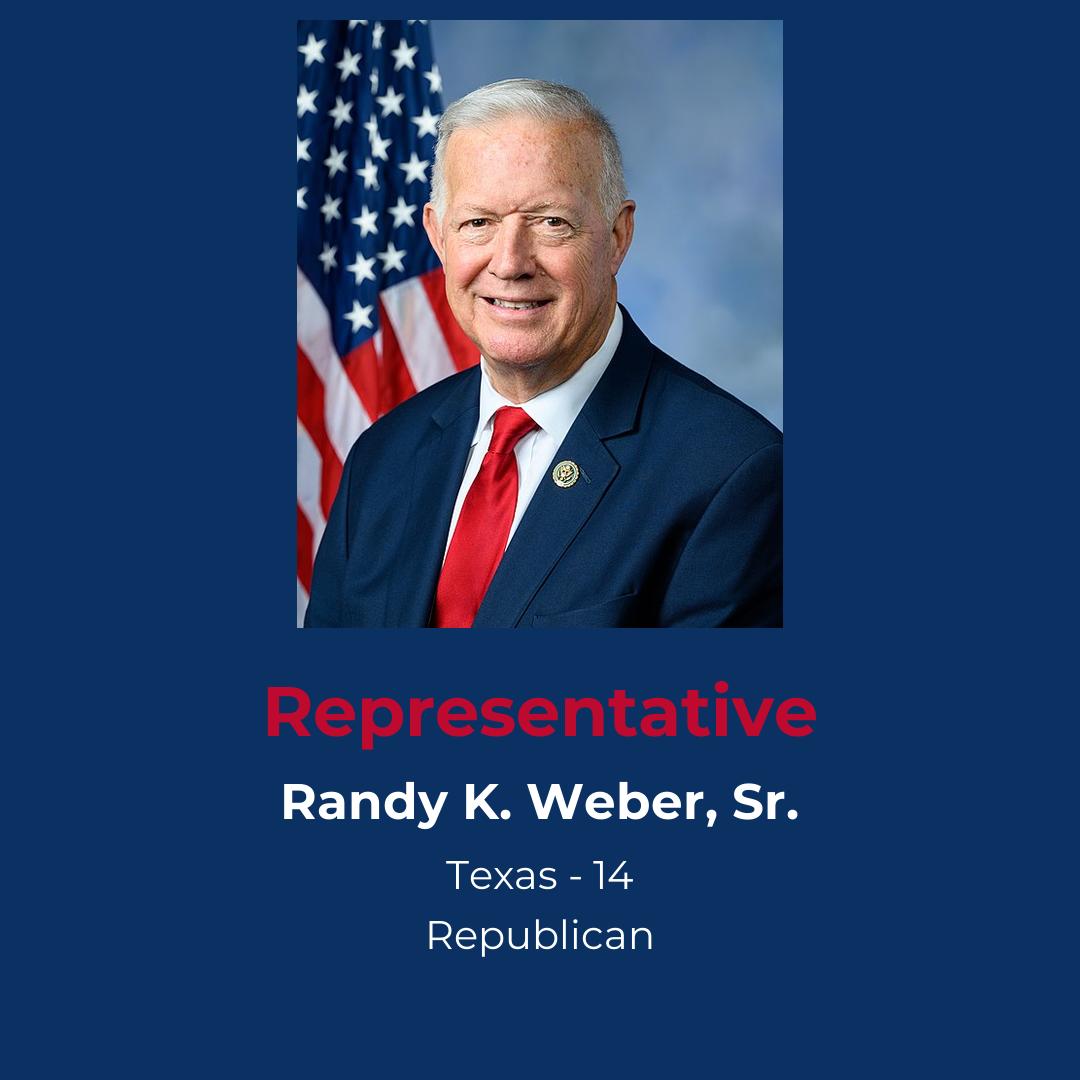
Randy Weber is a third-generation Texan who brings a blue-collar, small-business mindset to Washington. He built his own air conditioning company (Weber's Air & Heat) from scratch in 1981. He frequently cites this private-sector experience—relying on "good old-fashioned Texas horse sense"—as the foundation of his disdain for federal regulations and red tape.
He represents Texas’ 14th District, arguably the most critical energy and maritime district in the United States. Spanning the Gulf Coast from Freeport to Orange, the district contains seven ports, three massive LNG export terminals, some of America's largest refineries, and 60% of the nation's Strategic Petroleum Reserve.
In the 119th Congress (2025-2026), Weber received a massive boost in influence. He was named the Chairman of the Energy Subcommittee on the Science, Space, and Technology (SST) Committee, and the Vice Chairman of the Energy Subcommittee on the powerful Energy and Commerce (E&C) Committee.
He is intensely focused on protecting America's energy infrastructure. In February 2026, he successfully advanced the bipartisan Pipeline Cybersecurity Preparedness Act through subcommittee. This bill designates the Department of Energy as the lead agency to protect vulnerable U.S. pipelines from increasingly sophisticated cyberattacks.
Coastal resilience and waterway dredging are his primary local obsessions. He has secured hundreds of millions in Army Corps funding for the Sabine-Neches Waterway, the Galveston Ship Channel, and the Coastal Texas Project (the "Ike Dike"), arguing that protecting the Texas coast from hurricanes is a matter of strict national security, as 30% of the nation's refining capacity sits in his district.
"He spent thirty years fixing air conditioners in the Texas heat before heading to Washington. Now, Randy Weber controls the gavels that dictate the future of American energy dominance."
Randy Weber: The Energy Powerhouse
Randy Weber did not come to Congress from an elite law firm or a corporate boardroom; he came from the attic. Starting his own HVAC business, Weber’s Air & Heat, in 1981, he spent decades dealing directly with the grueling Texas summers and the frustrations of payroll, taxes, and local permitting. That real-world, small-business experience cemented his worldview: the federal government is usually the obstacle, not the solution.
His political career began on the Pearland City Council, moved to the Texas State House, and finally to the U.S. Congress in 2012, where he succeeded the legendary libertarian icon, Ron Paul. While he shares Paul's contempt for wasteful spending, Weber is a more traditional, born-again Christian conservative. He is unapologetically "America First," a fierce advocate for strict border enforcement, and a vocal supporter of the White House's 2025 executive actions to end catch-and-release policies and halt birthright citizenship for the children of illegal immigrants.
However, Weber’s true legacy is being built on energy and infrastructure. Representing the 14th District means representing the beating heart of the American blue economy. His district doesn't just produce energy; it refines it, stores it, and ships it to the rest of the world. In the 119th Congress, as Chairman of the SST Energy Subcommittee, Weber is in a prime position to dismantle what he views as the disastrous "anti-energy" policies of the previous administration. He was instrumental in drafting legislation to permanently end federal Electric Vehicle (EV) mandates and streamline the permitting process for new pipelines.
Weber understands that a hurricane hitting his district isn't just a local tragedy; it is a global economic event. He has been the relentless driving force behind securing federal appropriations for the Coastal Texas Project (often referred to as the "Ike Dike"), a massive system of storm surge barriers designed to shield the Galveston Bay region. By bringing home massive dredging funds for the Freeport and Beaumont ports, he ensures that the massive cargo ships and tankers that fuel the nation can navigate safely, proving that he knows exactly how to deliver for the Texas Gulf Coast.
District Context: Texas 14th (U.S. Census Data) The Gulf Coast Engine: The district stretches along the Gulf of Mexico, including the coastal and industrial hubs of Galveston, Beaumont, Port Arthur, Freeport, and League City.
Population: ~780,000.
Demographics:
Working-Class & Diverse: The district has a large, blue-collar workforce tied to the maritime and petrochemical industries. It is approximately 53% White, 25% Hispanic, and 16% Black.
Economic Drivers:
The Ports: Home to seven major ports, including the Port of Beaumont (one of the busiest military and commercial ports in the world) and the Port of Galveston (a massive hub for both cargo and the cruise ship industry).
Petrochemicals & LNG: The landscape is dominated by massive refineries, chemical plants, and Liquefied Natural Gas export terminals that supply global markets.
The Blue Economy: Texas A&M University at Galveston provides a major pipeline for maritime workforce development and oceanic research.
Politics: A Solid Republican district (R+17). Weber enjoys comfortable re-election margins, supported by an electorate that prioritizes energy sector jobs, deregulation, and strong national defense.
Source: U.S. Census Bureau & Data USA
#Representative #Texas #Republican #RandyKWeberSr