Show Notes
Key Takeaways (Click to Expand)
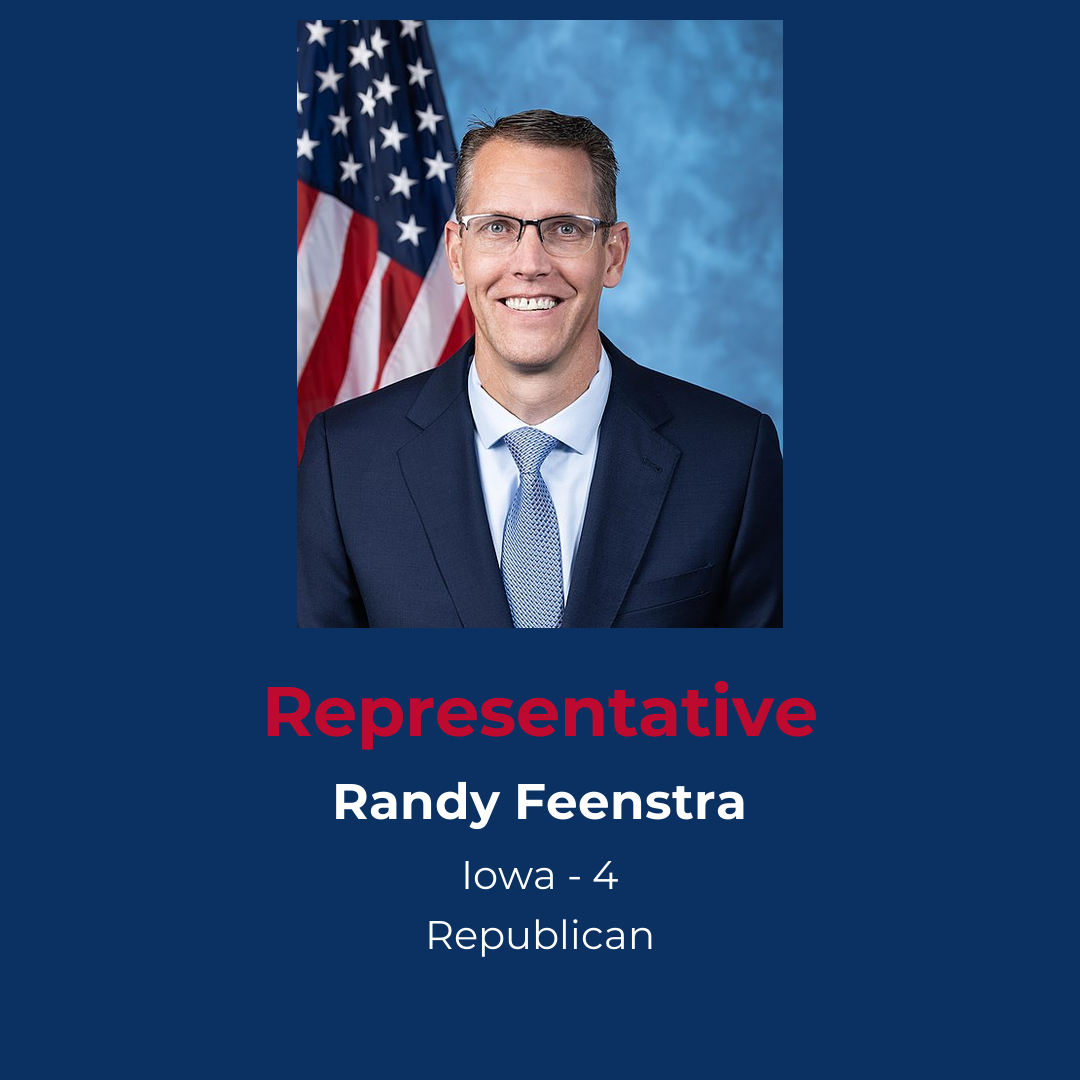
Randy Feenstra is a fiscal conservative and former City Administrator and County Treasurer who rose to national prominence in 2020 by defeating long-time incumbent Steve King in a primary, promising to trade "rhetoric for results."
He represents Iowa's 4th District, arguably the most agricultural district in the nation. It is a top producer of corn, soybeans, pork, and eggs, and is often called the "Saudi Arabia of Wind Energy" due to its massive wind turbine density.
Feenstra sits on two powerful committees for his district: the House Agriculture Committee and the Ways and Means Committee, where he focuses on protecting the step-up in basis for family farms and expanding biofuels (ethanol/biodiesel) markets.
His legislative style is defined by his background in local government—quiet, policy-focused, and obsessed with the math of the federal budget.
"He traded headlines for the Farm Bill. Randy Feenstra is the quiet accountant who ensures the nation's breadbasket has a seat at the writing table."
Randy Feenstra: The Fiscal Hawk of the Corn Belt
Representative Randy Feenstra’s path to Congress was paved with balance sheets. Before Washington, he spent years in local government in Hull, Iowa, first as a City Administrator and then as the Sioux County Treasurer. In those roles, he developed a reputation as a meticulous fiscal hawk, a trait he carried to the Iowa State Senate where he helped author the largest income tax cut in state history.
Feenstra entered the national spotlight in 2020 when he challenged and defeated nine-term incumbent Steve King in the Republican primary. His campaign argument was simple: the district needed a legislator, not a lightning rod. Since taking office, Feenstra has made good on that promise, keeping a low media profile while securing spots on the committees that matter most to his constituents: Agriculture and Ways and Means.
In Congress, Feenstra operates as a voice for "production agriculture." He is a fierce defender of the Renewable Fuel Standard (RFS), viewing ethanol and biodiesel not just as energy policy, but as a survival mechanism for Iowa corn and soy farmers. On the Ways and Means Committee, he fights to repeal the estate tax (the "Death Tax") and protect "step-up in basis," arguing that these tax structures are essential to keeping family farms in the family. He also champions the FARMLAND Act, legislation designed to prevent foreign adversaries (specifically China) from purchasing American agricultural land—a major concern in rural Iowa.
District Context: Iowa 4th (U.S. Census Data) The "Ag Super-District": Covering the northwest and north-central quadrant of Iowa, this district includes Sioux City, Fort Dodge, Marshalltown, and the college town of Ames (home to Iowa State University).
Population: ~753,000 (2024 Est.)
Economic Drivers:
Agriculture: This district consistently ranks among the top in the nation for pork, egg, corn, and soybean production.
Renewable Energy: Northwest Iowa has one of the highest concentrations of wind turbines on the planet, generating a massive surplus of green energy.
Education & Research: Iowa State University in Ames is a global hub for agricultural research and veterinary science.
Demographics: ~82% White, ~10% Hispanic. It is the most conservative district in Iowa (Cook PVI: R+16), heavily influenced by Dutch-American communities in Sioux County and evangelical voters.
Source: U.S. Census Bureau & USDA Ag Census
Sources Used Official Biography: https://feenstra.house.gov/about
Ballotpedia Profile: https://ballotpedia.org/Randy_Feenstra
GovTrack.us Legislative Record: https://www.govtrack.us/congress/members/randy_feenstra/456803
USDA Ag Census Data: https://www.nass.usda.gov/
#Representative #Iowa #Republican #RandyFeenstra