Show Notes
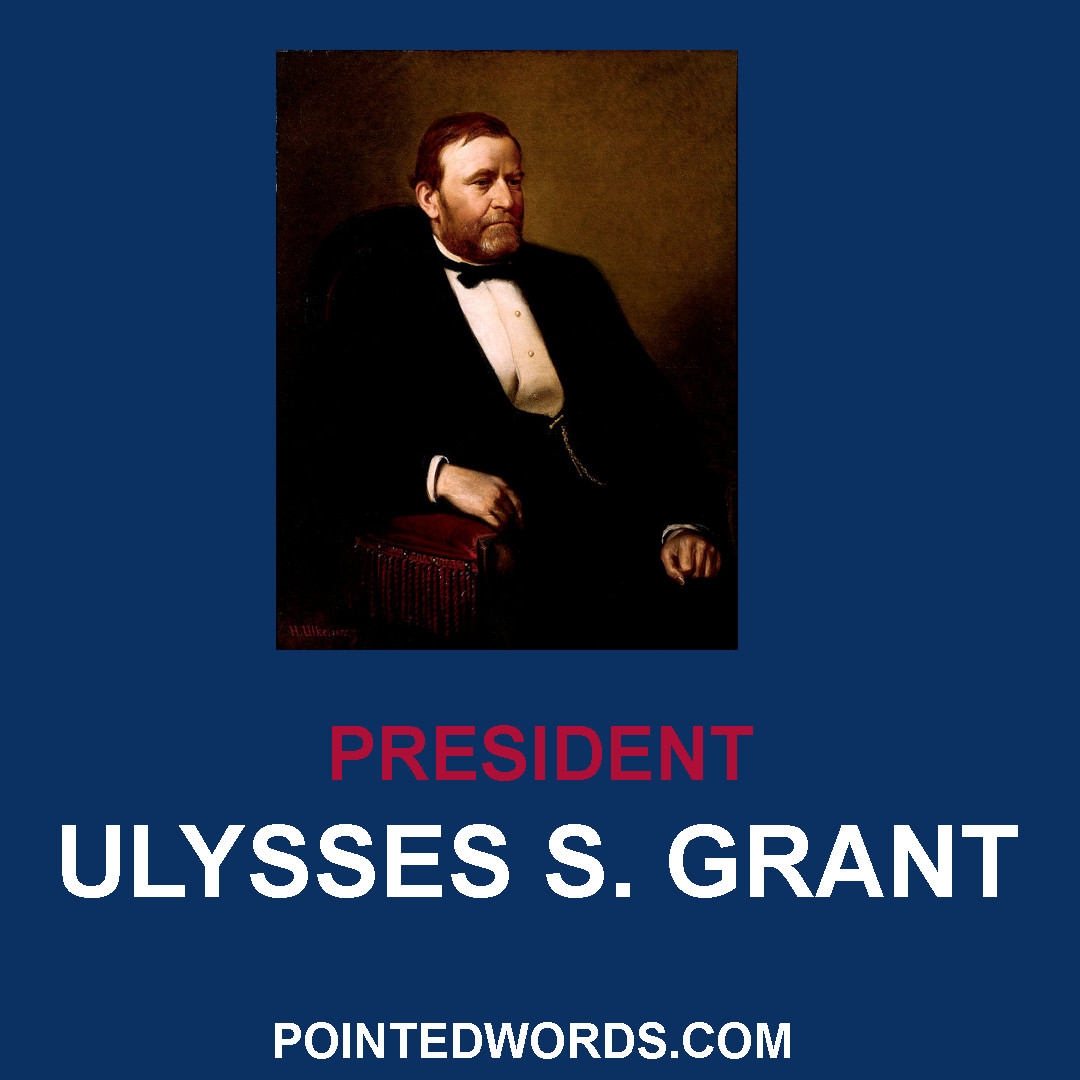
Ulysses S. Grant was the 18th President of the United States (1869–1877). Before entering the White House, he was the legendary Commanding General of the Union Army who led the United States to victory over the Confederacy in the American Civil War.
He is historically recognized as one of the greatest military commanders in American history, yet his two-term presidency is often debated due to a mix of monumental civil rights achievements and severe cabinet-level corruption.
The Civil Rights Champion: Grant was fiercely dedicated to protecting the newly freed African American population during Reconstruction. He championed the 15th Amendment (guaranteeing voting rights for Black men), signed the Enforcement Acts, and created the Department of Justice specifically to crush the Ku Klux Klan and domestic terrorism in the South.
The Scandals: While Grant himself was fundamentally honest, he was incredibly naive as a politician and notoriously loyal to a fault. His administration was plagued by massive corruption scandals—most notably the Whiskey Ring and the Crédit Mobilier scandal—which severely tarnished his reputation.
A Heroic Final Act: After leaving office, Grant lost his entire life savings to a Wall Street swindler. Dying of throat cancer, he spent his final months in a desperate race against time to write his memoirs to save his family from financial ruin. Published by Mark Twain shortly after Grant's death, the memoirs became a massive financial success and a literary masterpiece.
"He won the bloodiest war in American history and used the presidency to crush the Ku Klux Klan. Ulysses S. Grant was a brilliant general, a fierce defender of civil rights, and a man whose greatest flaw was trusting the people around him."
Day 60 | Ulysses S. Grant: The General Who Fought for the Peace
The life of Ulysses S. Grant is a story of profound failure followed by staggering, world-altering success. Born in Ohio in 1822, Hiram Ulysses Grant (a clerical error at West Point changed his name forever) was an unexceptional student who hated the sight of blood and had no desire to be a soldier. After serving with distinction in the Mexican-American War, he resigned from the Army amid rumors of heavy drinking. For the next decade, he failed at almost everything he tried: farming, real estate, and bill collecting. By the time the Civil War broke out in 1861, the 39-year-old Grant was working as a clerk in his father’s leather shop in Galena, Illinois, struggling to feed his family.
The Civil War unlocked his latent genius. While other Union generals hesitated, Grant understood the brutal, mathematical reality of modern warfare. Following his massive victories at Shiloh, Vicksburg, and Chattanooga, President Abraham Lincoln promoted him to Commanding General of the entire Union Army. Grant waged a relentless, grinding campaign against Robert E. Lee in Virginia, finally forcing Lee's surrender at Appomattox Court House in 1865. Overnight, the failed leather clerk became the undisputed savior of the American Republic.
Riding a wave of immense national popularity, Grant was unanimously nominated by the Republican Party and easily won the presidency in 1868. His campaign slogan was simply, "Let us have peace."
However, the presidency required a different kind of warfare. Inheriting a deeply fractured nation from the disastrous Andrew Johnson administration, Grant used the power of the federal government to enforce Radical Reconstruction. He viewed the Ku Klux Klan not as a political organization, but as a violent domestic insurgency. To destroy them, Grant signed the Enforcement Acts and officially established the United States Department of Justice in 1870, directing his new Attorney General to dispatch federal troops and prosecutors to the South to hunt down and dismantle the Klan. Furthermore, he heavily pushed for the ratification of the 15th Amendment, theoretically guaranteeing the right to vote for Black men.
Despite his noble intentions regarding civil rights, Grant’s administration was politically disastrous. Operating with the mindset of a military commander, he expected absolute loyalty from his cabinet but failed to realize he was surrounded by opportunistic grifters. His two terms were rocked by massive financial scandals. During the "Whiskey Ring" scandal, millions of dollars in federal taxes were siphoned off by distillers and government officials, including Grant's own personal secretary. While Grant was never personally implicated in the theft, his fierce loyalty to his friends blinded him to their corruption, allowing the political elite to brand his administration as deeply unethical.
Coupled with the devastating economic collapse of the Panic of 1873, Grant left office in 1877 exhausted and unpopular. Yet, his final chapter remains one of the most heroic in American history. Bankrupted by a Wall Street Ponzi scheme in 1884 and diagnosed with terminal throat cancer, Grant spent his final year agonizingly writing his military memoirs. Functioning on pure willpower and cocaine swabs for the pain, he finished the manuscript just days before his death in July 1885. Published by his friend Mark Twain, The Personal Memoirs of U. S. Grant secured his family's financial future and solidified his legacy not as a politician, but as the quiet, iron-willed general who saved the Union.
Constituency Context: The United States (1869–1877) Population: ~38.5 Million (by the 1870 Census).
The Gilded Age Begins: Grant's presidency marked the beginning of a massive, unregulated economic boom driven by industrialization and the completion of the First Transcontinental Railroad in 1869, which physically connected the East and West coasts.
The Panic of 1873: The post-war economic boom came to a crashing halt when the over-expansion of the railroad industry caused a massive banking collapse. The resulting economic depression lasted for years, devastating working-class families and severely weakening the Republican Party's political power.
Native American Policy: Grant attempted to implement a "Peace Policy" to replace military conflict with the assimilation of Native American tribes. However, the policy failed disastrously. The discovery of gold in the Black Hills led to the Great Sioux War of 1876, culminating in the famous Battle of the Little Bighorn (Custer's Last Stand).
Source: U.S. Census Bureau & The Miller Center